More Than a Lifetime: Consciousness, God and Our Search for Meaning
We can imagine the universe continuing for billions of years, yet struggle to imagine the disappearance of our own awareness. We know that people die. Understanding what it would mean to stop experiencing anything is another matter entirely.
This tension sits beneath some of humanity’s oldest questions—and some of its newest theories. Is there a God? Does consciousness survive the body? Are we connected through a universal mind? Could we be living in a simulation, with death marking a transition into another reality?
These questions are about the nature of existence. They are also about love, loss and the hope that our lives matter beyond the time we spend here.
Are we discovering something deeper about reality, or searching for explanations that make mortality easier to bear?
Both possibilities deserve consideration. Our desire for reassurance can shape what we believe, but it does not automatically make a belief false. Equally, an idea’s ability to comfort us does not make it true.
Consciousness makes this especially difficult. It is the intimate fact of experience: the taste of coffee, the ache of grief, the awareness that you are reading these words. We experience everything through it, yet still lack a settled explanation of how it arises.
Scientists can investigate relationships between brain processes and conscious experience without having resolved every question about why experience exists. A major study published in Nature in 2025 tested two leading theories of consciousness and challenged important predictions of both. The uncertainty is real, but it is an invitation to further investigation, not proof of an afterlife or a universal mind. Reference: COGITATE Consortium, 2025.
Faith and life beyond death
Religion places human life within a sacred context. For many believers, God provides a foundation for purpose, moral responsibility and hope. Death may be understood through resurrection, continued spiritual existence or another form of life beyond this one. Other traditions describe rebirth or liberation, with different understandings of what, if anything, remains of the individual. These beliefs should not be flattened into a single claim that “we all go somewhere else.” Reference: Stanford Encyclopedia of Philosophy, “Afterlife”.
Faith can also concern how to live now: how to forgive, endure suffering, care for others and relate to what is considered sacred. Reducing religion to fear of death overlooks much of what it means to those who practise it.
Nevertheless, the possibility that love and identity might endure gives religious hope a particular emotional force. When someone we love dies, the question of continued existence becomes painfully specific. We are asking whether that person—their humour, memories and familiarity—is still present somewhere.
Is reality a simulation?
Modern technological ideas can offer a different language for a similar hope.
In his 2003 simulation argument, philosopher Nick Bostrom proposed that at least one of three broad possibilities holds: civilisations rarely reach the ability to produce vast numbers of simulated human histories; those that can rarely choose to do so; or simulated observers vastly outnumber original observers, making it likely that we are simulated ourselves. The argument depends on assumptions about technology, consciousness and the behaviour of advanced civilisations. It is not a discovery that our universe is a computer program. Reference: Bostrom, “Are You Living in a Computer Simulation?”.
Yet it is easy to imagine an additional story: perhaps death is waking up outside the simulation. Perhaps someone is watching over us. Perhaps our difficulties are lessons within a larger experience.
Those ideas go beyond Bostrom’s argument. Even a simulated world would not guarantee that its inhabitants continue after death, that its creators care about them, or that every life has an assigned purpose.
There is an interesting resemblance here to some religious narratives: a reality beyond our perception, a creator outside our world, and the possibility that apparent death is not final. The resemblance is an interpretation, not evidence that religion and simulation theory describe the same thing. A simulation’s programmer would not automatically possess the qualities that believers attribute to God.
Collective consciousness and shared meaning
Collective consciousness offers another possibility: perhaps we are less separate than we feel.
In its social meaning, collective consciousness concerns shared beliefs and values. Sociologist Émile Durkheim explored how religious rituals and communal life help people experience belonging to something greater than themselves. A congregation singing, a community mourning or a crowd celebrating can make that connection tangible. His account explains a social dimension of religion; it does not settle whether God exists. Reference: Durkheim, The Elementary Forms of the Religious Life.
Research also shows that aspects of brain activity can become synchronised during communication. Such findings help explain how people share meaning, but do not establish telepathy or a single consciousness connecting all minds. Reference: Princeton Neuroscience Institute, 2024.
Spiritual interpretations go further, imagining individual minds as expressions of universal awareness. The familiar image is an ocean: each person is a wave, temporarily distinct but never truly separate from the whole.
It is a beautiful metaphor. It also leaves a difficult question unanswered. If the wave returns to the ocean, what happens to the particular person? Would your memories, relationships and sense of identity remain? The continuation of universal awareness would not necessarily mean that you continue as yourself.
A related philosophical position, panpsychism, proposes that basic forms of experience are fundamental and widespread in nature. One of its central difficulties is explaining how those basic experiences could combine into a unified human mind. It offers a way of approaching consciousness, not established evidence of personal survival after death. Reference: Stanford Encyclopedia of Philosophy, “Panpsychism”.
Quantum ideas and the limits of inference
Quantum physics adds another layer of fascination. Because it challenges everyday intuition, it is tempting to treat it as an opening through which almost any extraordinary possibility might enter. But an unfamiliar scientific result does not make every interpretation of it equally credible.
Roger Penrose and Stuart Hameroff’s Orch OR proposal suggests that quantum processes in structures inside brain cells contribute to consciousness. This is a proposed explanation, not an established account of awareness. Even demonstrating such a mechanism would leave a further question: why would those processes preserve a person’s identity after death? A quantum explanation of consciousness would not, by itself, establish an afterlife. Reference: Hameroff and Penrose, 2014.
Similarly, “quantum immortality”—the suggestion that awareness must continue in a surviving branch of reality—is not a demonstrated consequence of quantum physics. Researcher Jacques Mallah has argued specifically against the claim that the many-worlds interpretation implies guaranteed personal survival. Reference: Mallah, research preprint, revised 2011.
An explanation of consciousness, an explanation of purpose and evidence of life after death are three separate achievements. We often move between them so quickly that we overlook the missing steps.
Why these possibilities attract us
Why do these possibilities attract us so strongly?
One psychological explanation is terror management theory, which proposes that cultural worldviews and self-esteem help people manage awareness of mortality. A 2010 meta-analysis of 277 experiments found support for the influence of death reminders on how people defend their worldviews and self-esteem. This offers one lens on human belief, rather than a complete explanation of religion or any particular person’s convictions. Reference: Burke, Martens and Faucher, 2010.
We should also distinguish two wishes that are easily confused: wanting to continue existing and wanting our existence to have mattered.
Living forever would not automatically provide purpose. An endless life could still contain loneliness, confusion or cruelty. Conversely, a finite life can contain love, discovery and profound significance.
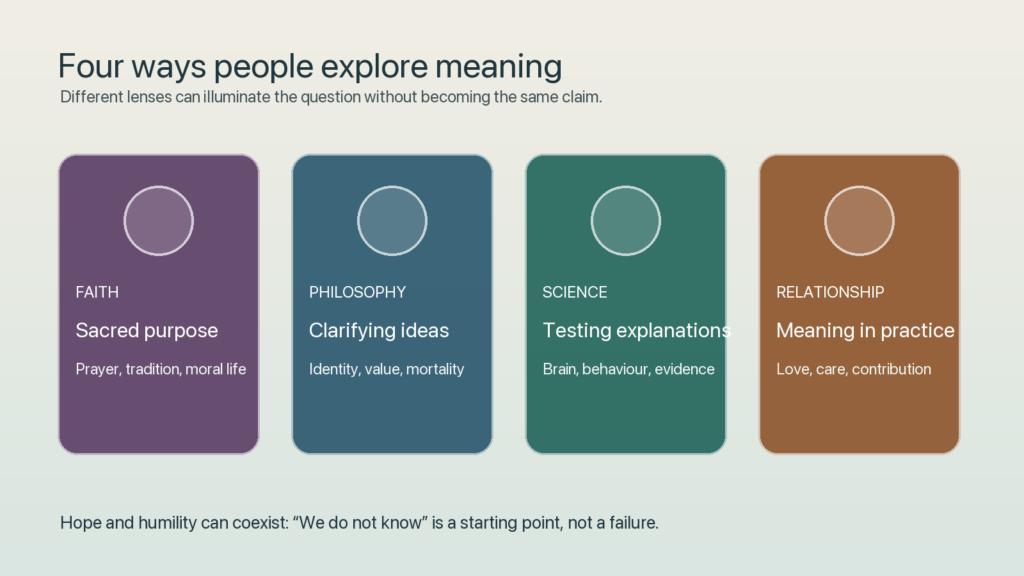
The perspective offered here is that humanity’s search for a larger story expresses both vulnerability and imagination. We recognise the limits of our lives, then reach beyond them through faith, philosophy and science. That reaching can produce insight. It can also tempt us to turn an unanswered question into a comforting certainty.
A thoughtful response leaves room for hope while remaining willing to say, “We do not know.”
Someone can believe in God without claiming that quantum physics proves their faith. Someone can question an afterlife without dismissing the depth of another person’s spiritual experience. Someone can investigate simulation theory without assuming that death is an exit door.
Meanwhile, the consequences of our lives are already unfolding in other people. A patient teacher changes what a child believes is possible. A friend’s kindness becomes something another person remembers during a difficult year. Care received can become care passed on.
This influence is not proof of continued consciousness, and it cannot replace the person who has died. But it is one concrete way that a life reaches beyond its own boundaries.
Perhaps purpose can be found through a relationship with God, built through human connection, or understood through both. Perhaps some of our deepest questions will remain unanswered throughout our lifetimes. Neither possibility prevents us from taking this life seriously.
A friendship does not become meaningless because it ends. Relief from suffering matters even when it is temporary. Love does not need an infinite duration to have been real.
We can keep asking whether something awaits us beyond death. While we ask, other conscious beings are here beside us—capable of joy, afraid of loss, and searching for meaning too.
Whatever the ultimate nature of reality, how we treat them matters now.