Psilocybin Mushrooms and Medication: What Should Not Be Combined—and Why There Is No DIY “Washout” Period
Educational information only. This article does not provide medical advice or instructions for using psilocybin. Do not stop, reduce, skip, or change prescribed medication to prepare for a psychedelic experience. Speak to the prescribing clinician and a medically qualified psychedelic-service provider. If they cannot safely agree on a plan, postpone the journey.
Psilocybin is converted in the body to psilocin and affects serotonin signalling. Its effects can vary widely with dose, health, mood, setting, mushroom species and the use of other substances.[1] Research on medicine interactions is still incomplete, and advice developed for a closely monitored clinical trial should not be copied into an unsupervised setting.[2]
The short answer about “how long”
There is no single safe number of days to be off medication before a psilocybin journey. The answer depends on the exact medicine, dose, formulation, duration of treatment, active metabolites, liver and kidney function, the condition being treated, withdrawal risk and the person’s psychiatric and medical history.
Many research protocols have historically required antidepressants to be stopped for at least two weeks before psychedelic administration.[2] That is a study rule—not a universal safety guarantee. Newer evidence also questions whether routine antidepressant discontinuation is necessary and warns that stopping can worsen depression, increase suicidal thinking or cause a discontinuation syndrome.[2]
Some medicines take longer to clear than others, but drug clearance is only one part of the question. Withdrawal, relapse and lingering changes in drug response can last longer than the medicine’s presence in the blood. A retrospective survey found that reduced psilocybin effects reported after SSRI/SNRI discontinuation sometimes persisted for months, which shows why a simple “washout equals ready” formula is unreliable.[6]
Antidepressants should not usually be stopped suddenly. The Royal College of Psychiatrists advises that tapering may take weeks or months and should be planned with the prescriber; the schedule is individual.[3] The safest public guidance is therefore not a countdown: do not stop medication for a journey without a clinician-led plan.
Combinations that need particular caution
Lithium: do not combine
Lithium is the clearest high-risk warning. An analysis of online experience reports found seizures in 47% of 62 reports involving lithium plus a classic psychedelic, and 39% involved medical attention. The evidence is observational and cannot establish a precise rate for all users, but the signal is serious enough that the authors provisionally concluded that the combination may pose a significant seizure risk.[4]
Do not stop lithium simply to become eligible for a journey. Abrupt or poorly supervised changes can destabilise the condition it is treating. If lithium is part of the medication list, the journey should be postponed unless the prescribing specialist and the treating psychedelic clinician agree that participation is medically appropriate.
Monoamine oxidase inhibitors (MAOIs): avoid without specialist oversight
MAOIs include medicines such as phenelzine, tranylcypromine, isocarboxazid and some forms or doses of selegiline. Combining an MAOI with another psychoactive substance can create unpredictable intensity and cardiovascular or serotonin-related risk. Current clinical guidance commonly treats psilocybin with MAOIs as a combination to avoid.[2]
There is no responsible do-it-yourself washout period for an MAOI. These medicines have important drug and food interactions, and the biological effect can outlast the final tablet. Any change requires the prescribing doctor or pharmacist.
Antidepressants: evidence is mixed, so individual review matters
SSRIs and SNRIs—such as fluoxetine, sertraline, escitalopram, venlafaxine and duloxetine—may blunt or alter the acute psychedelic effect. Survey data found weaker-than-expected effects were reported more often with SSRIs and SNRIs than with bupropion.[6] However, a 2025 scoping review found that concomitant antidepressant use with classic psychedelics was generally safe and tolerable in the limited human literature, particularly for psilocybin, while also stressing major evidence gaps.[2]
This uncertainty is exactly why readers should not stop an antidepressant based on a chart or online post. A weaker experience is not a reason to take more, and it is not proof that the combination is safe. The prescriber should assess the risks of continuing, tapering, relapse and withdrawal for the individual.
Tricyclic antidepressants, trazodone, mirtazapine, buspirone and bupropion have different mechanisms and risk profiles. They should not be treated as interchangeable with SSRIs. Each exact medicine needs to be checked by name, dose and formulation.
Antipsychotics and mood stabilisers: do not discontinue for a journey
Antipsychotics may reduce psychedelic effects because many block serotonin receptors involved in the psilocybin response. More importantly, stopping an antipsychotic or mood stabiliser can increase the risk of relapse, mania or psychosis. Psilocybin is not considered safe for people with psychotic disorders or severe forms of bipolar disorder.[1]
Medication changes in this group require specialist psychiatric oversight. A personal or family history of psychosis or bipolar disorder should be disclosed during screening even if no medication is currently used.
Benzodiazepines, sedatives and alcohol: do not improvise
Benzodiazepines may reduce anxiety and psychedelic intensity in medical settings, but regular users can experience severe withdrawal—including seizures—if they stop suddenly. Sedatives, sleeping tablets, alcohol, opioids and other substances can also impair judgement, breathing, coordination or the ability to respond to distress. Do not skip a regular sedative or combine substances in an attempt to shape the journey without medical direction.
Stimulants and medicines that raise blood pressure or seizure risk
Psilocybin can temporarily increase heart rate and blood pressure.[1] Prescription stimulants, decongestants and other sympathomimetic medicines may add cardiovascular strain. Tramadol and some other medicines can also lower the seizure threshold or affect serotonin. People with uncontrolled hypertension, significant heart disease, a seizure disorder or a history of stroke need medical assessment before any consideration of psychedelic exposure.
A safer medication-review process
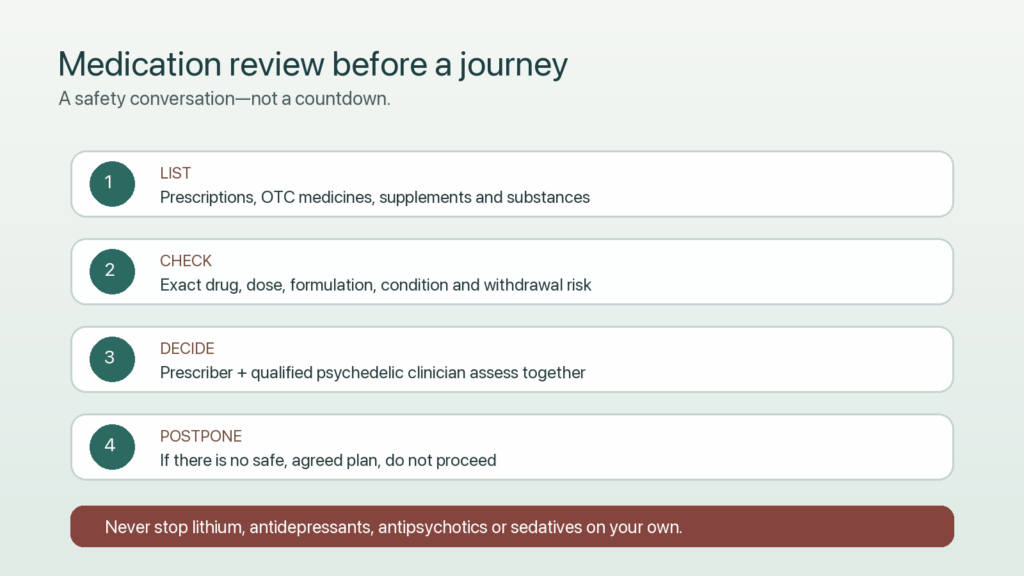
Before any medically supervised psilocybin session, provide the clinician with a complete written list of:
- prescription medicines, including “as needed” doses;
- over-the-counter medicines, especially cough, cold, sleep and pain products;
- vitamins, herbal products and supplements;
- cannabis, alcohol, nicotine and other psychoactive substances;
- recent medication changes, missed doses and previous withdrawal symptoms; and
- relevant heart, neurological and psychiatric history.
A responsible service should include preparation, eligibility screening, informed consent, an individual safety-and-support plan and transport planning. Oregon’s regulated model requires these steps and follow-up after the session, illustrating that medication screening belongs inside a broader safety system—not in a last-minute checklist.[5]
When to get urgent help
Seek emergency medical care for a seizure, loss of consciousness, chest pain, severe headache, very high temperature, marked agitation, rigid muscles, severe confusion, fainting, difficulty breathing or a dangerously fast or irregular heartbeat. Tell responders exactly what was taken, including medicines, supplements and substances. Accurate information helps treatment; do not hide a substance because of embarrassment.
Bottom line
The safest answer to “How long should I stop my medication before a journey?” is: do not choose a washout period yourself. Lithium and MAOIs raise particular concern; many other medicines can alter effects or add psychiatric, cardiovascular, serotonin-related, sedation or seizure risks. For antidepressants, current evidence is more nuanced than many online charts suggest, and the danger of withdrawal or relapse may outweigh any theoretical benefit of stopping.
A journey can be postponed. A necessary medicine should never be abruptly stopped to meet a date.
Sources
- 1 — NCCIH: Psilocybin for Mental Health and Addiction
- 2 — Concomitant use of antidepressants and classic psychedelics: a scoping review
- 3 — Royal College of Psychiatrists: Stopping antidepressants
- 4 — Classic Psychedelic Coadministration with Lithium
- 5 — Oregon Psilocybin Services: Health and Safety
- 6 — Attenuation of psilocybin mushroom effects during and after SSRI/SNRI use